




January 2023
Basic Hygiene for Healthy Feet
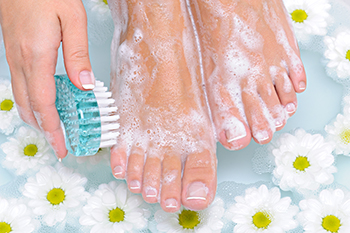
Even though our feet carry us throughout the day, they are often neglected when it comes to hygiene. Experts agree that many diseases and foot conditions can be prevented if you take care of your feet. Recommendations include doing simple tasks, like washing and drying the feet daily, keeping toenails trimmed straight across and not cut too short, and changing your socks each day. It is also recommended that shoes fit properly and be alternated to give them a chance to air out and help ward off bacterial infections. Of utmost importance to warding off infections is careful and frequent monitoring of cuts, sores, and bruises on the feet and toes. Special attention should be placed on the soles of the feet, which are hard to see and often forgotten. Several conditions directly related to foot hygiene are fungal infections like athlete’s foot, nerve and blood flow problems caused by diabetes, and ingrown toenails. For more information on proper foot hygiene, please consult a podiatrist.
Everyday foot care is very important to prevent infection and other foot ailments. If you need your feet checked, contact the podiatrists from Issaquah Foot & Ankle Specialists. Our doctors can provide the care you need to keep you pain-free and on your feet.
Everyday Foot Care
Often, people take care of their bodies, face and hair more so than they do for their feet. But the feet are a very important aspect of our bodies, and one that we should pay more attention to. Without our feet, we would not be able to perform most daily tasks.
It is best to check your feet regularly to make sure there are no new bruises or cuts that you may not have noticed before. For dry feet, moisturizer can easily be a remedy and can be applied as often as necessary to the affected areas. Wearing shoes that fit well can also help you maintain good foot health, as well as making it easier to walk and do daily activities without the stress or pain of ill-fitting shoes, high heels, or even flip flops. Wearing clean socks with closed shoes is important to ensure that sweat and bacteria do not accumulate within the shoe. Clean socks help to prevent Athlete’s foot, fungi problems, bad odors, and can absorb sweat.
If you have any questions, please feel free to contact one of our offices located in Issaquah, WA . We offer the newest diagnostic and treatment technologies for all your foot care needs.
Do You Suffer From Painful Feet?
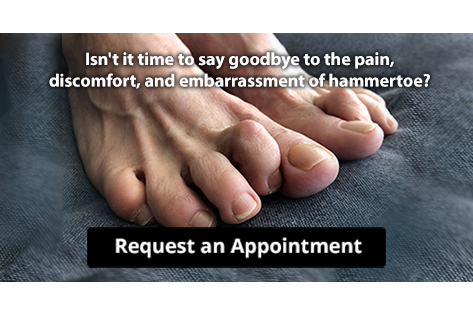
Painful deformities, such as hammertoes, can be treated. Stop living with foot pain, and have beautiful feet again!
Foot and Ankle Surgery
When conservative, noninvasive methods prove ineffective, surgery may be selected as the next course of action for the treatment of your foot or ankle condition. A wide number of foot and ankle surgical procedures exist, and it is up to your podiatrist to determine which intervention will be most appropriate and helpful for your case. Some surgical procedures include bunion surgery, fusion, hammertoe surgery, heel spur surgery, metatarsal surgery, nail surgery, neuroma surgery, reconstructive surgery, skin surgery, and tendon surgery. Typically, surgery is turned to as a definitive way to alleviate excessive pain or discomfort and to return your foot to full mobility.
Regardless of the location on the body, all surgical procedures require preoperative testing and examination to ensure the surgery’s success and preferred outcome. A review of your medical history and medical conditions will take place, as will an evaluation of any current diseases, illnesses, allergies, and medications. Tests such as blood studies, urinalyses, EKG, X-rays, and blood flow studies may be ordered. Because the procedure involves the foot and/or ankle, the structures of your feet while walking may also be observed by your podiatrist.
Care post-surgery will depend on the type of surgical procedure performed. Typically, all postoperative care involves rest, ice, compression, and elevation. To improve and ensure a safe recovery, your foot and ankle surgeon may also employ the use of bandages, splints, surgical shoes, casts, crutches, or canes. He will also determine if and when you can bear weight. A timely and thorough recovery is a priority for both you and your podiatrist, and carefully following postoperative instructions can help achieve this.
Morton’s Neuroma Surgery
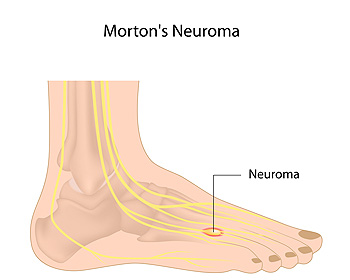
Sometimes, certain afflictions of the foot can be so severe that they can only be treated properly by undergoing a kind of surgical procedure. It is important to note that foot surgery is not for everyone and you may not be a good candidate for particular surgical procedures. However, sometimes undergoing a surgical procedure can be beneficial and it might be the only way to treat severe conditions. For example, some individuals can benefit from a surgical procedure for Morton’s neuroma. This condition is defined as the swelling or inflammation of the nerve between the toes or metatarsal bones. The surgical procedure to address Morton’s neuroma consists of removing a small section of the nerve. An incision must be made to get to the damaged nerve and then the skin is quickly sewn up following the removal of the nerve. Contact a podiatrist today for more information about Morton’s neuroma or to learn if you might be a good candidate for surgery.
Foot surgery is sometimes necessary to treat a foot ailment. To learn more, contact the podiatrists of Issaquah Foot & Ankle Specialists. Our doctors will assist you with all of your foot and ankle needs.
When Is Surgery Necessary?
Foot and ankle surgery is generally reserved for cases in which less invasive, conservative procedures have failed to alleviate the problem. Some of the cases in which surgery may be necessary include:
- Removing foot deformities like bunions and bone spurs
- Severe arthritis that has caused bone issues
- Cosmetic reconstruction
What Types of Surgery Are There?
The type of surgery you receive will depend on the nature of the problem you have. Some of the possible surgeries include:
- Bunionectomy for painful bunions
- Surgical fusion for realignment of bones
- Neuropathy decompression surgery to treat nerve damage
Benefits of Surgery
Although surgery is usually a last resort, it can provide more complete pain relief compared to non-surgical methods and may allow you to finally resume full activity.
Surgical techniques have also become increasingly sophisticated. Techniques like endoscopic surgery allow for smaller incisions and faster recovery times.
If you have any questions, please feel free to contact one of our offices located in Issaquah, WA . We offer the newest diagnostic and treatment technologies for all your foot care needs.
