




April 2022
Blisters Will Gradually Drain
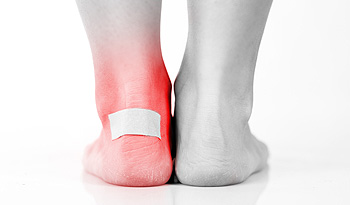 A small area on the skin that is filled with liquid and resembles a bubble is referred to as a blister. Its function is to protect the damaged skin while new skin grows, and will gradually drain when the body no longer needs it. A blister often develops as a result of excessive friction from wearing shoes that do not fit correctly. Additionally, blisters can form from certain medical conditions, including psoriasis, frostbite, and eczema. An allergic reaction to an insect bite may cause a blister, or one may develop from specific types of chemicals. The blister can be protected by placing a bandage over it, as daily activities are completed. If you frequently develop blisters on your feet, please consult with a podiatrist who can provide you with reasons why and suggest correct preventative techniques.
Blisters may appear as a single bubble or in a cluster. They can cause a lot of pain and may be filled with pus, blood, or watery serum. If your feet are hurting, contact the podiatrists of Issaquah Foot & Ankle Specialists. Our doctors can provide the care you need to keep you pain-free and on your feet.
Foot Blisters
Foot blisters are often the result of friction. This happens due to the constant rubbing from shoes, which can lead to pain.
What Are Foot Blisters?
A foot blister is a small fluid-filled pocket that forms on the upper-most layer of the skin. Blisters are filled with clear fluid and can lead to blood drainage or pus if the area becomes infected.
Symptoms
(Blister symptoms may vary depending on what is causing them)
- Bubble of skin filled with fluid
- Redness
- Moderate to severe pain
- Itching
Prevention & Treatment
In order to prevent blisters, you should be sure to wear comfortable shoes with socks that cushion your feet and absorb sweat. Breaking a blister open may increase your chances of developing an infection. However, if your blister breaks, you should wash the area with soap and water immediately and then apply a bandage to the affected area. If your blisters cause severe pain it is important that you call your podiatrist right away.
If you have any questions, please feel free to contact one of our offices located in Issaquah, WA . We offer the newest diagnostic and treatment technologies for all your foot care needs.
Dr Brandon Nelson, A Board-Certified Physician & Surgeon, Discusses The Newest Bunion Surgery Technique
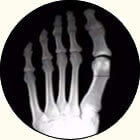
Bunions can be quite painful for many people. They can begin to interfere with activities and make exercising difficult. Additionally, it can become difficult to find shoe gear that fits properly. Most bunions are a genetic condition that is inherited and develops with time and loading of the foot. Many bunions get bigger as time goes on and eventually require surgical repair. Surgery for a bunion can be broken down into two categories what are called head procedures and base procedures. Today I will only discuss a base procedure as this seems to be the most common question lately.
Base procedures are often used for large bunions and can be a powerful tool to correct the foot. The base procedure is usually further divided into joint sparing procedures and joint destructive procedures. The most asked about procedure currently is the Lapiplasty. The Lapiplasty is a procedure based off a technique described by Paul Lapidus. It involves removing a joint in the foot that is the apex of the bunion deformity. The reason this procedure is so effective is it eliminates the primary cause of the bunion, the hypermobile joint that initiated the development of the bunion.
Lapiplasty is a tool set that is provided to make the Lapidus bunion surgery easier. This is a technique that has been utilized for years however this instrument set is the first of its kind and has helped make this procedure more reproducible. This is the most common bunion procedure I execute as it has great correction and great long-term outcomes. If you have a bunion and would like a consultation, make an appointment today and I can help.
Give us a call at 425-391-8666 or make an appointment online.
Sincerely,
Board Certified Physician and Surgeon
Dr. Timothy Young, Board Certified Foot and Ankle Surgeon, Talks About Hallux Limitus Surgery
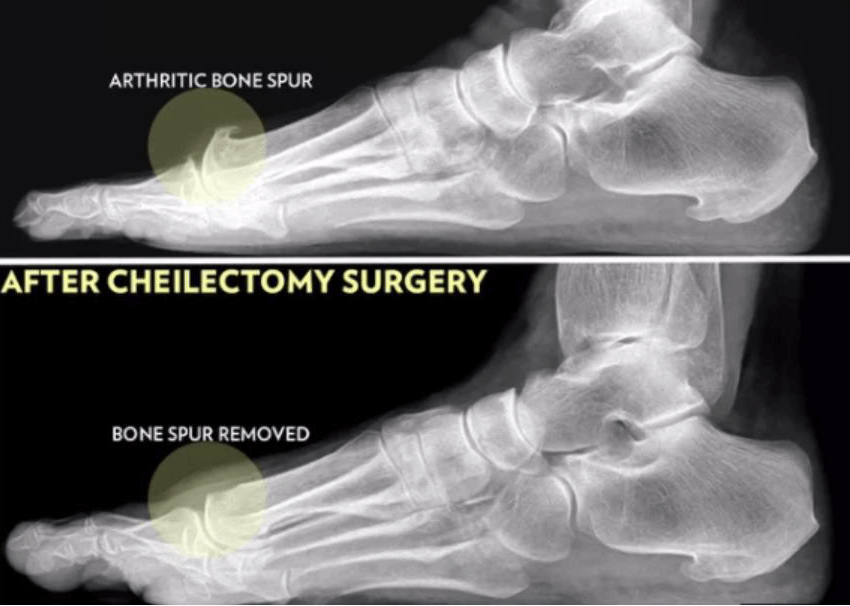
Dr. Timothy Young, board certified foot and ankle surgeon, talks about hallux limitus surgery for arthritic bone spur removal of the great toe.
Arthritis of the great toe is very common. Usually there is excessive compression on the top of the joint, and over months to years, painful bone spurs or osteophytes can develop. These create even more pressure and pain, and there is often bone on bone contact between these bone spurs. Removal of the bone spur is a very effective treatment for this problem. This surgery is called a cheilectomy. Cheilectomy surgery for arthritis of the great toe is quite straightforward and has a rapid recovery. Cheilectomy surgery is the most basic and simple procedure, from a surgical perspective for this condition.
There are more and fall procedures that can be done such as a decompression osteotomy of the bone, or fusion of the joint. These procedures usually require significant additional protection and recovery time. The surgical procedure itself involves access to the joint with an incision through the tissue layers including the joint capsule. The bone spurs are then exposed and removed surgically. This also involves using a surgical bur to smooth down the top of the joint. It is quite common to fine small loose fragments of bone, which are also removed during the procedure. If there are loose flaps of cartilage, and failure removed and the exposed bone can be drilled to create a fibrocartilage patch.
The joint and wound is flushed and then the layers are repaired and sutured. Recovery involves using a surgical shoe or cast boot. Initially putting weight on the heel for the first few days, and after that for weight with a surgical shoe or cast boot works well. Sutures are typically removed 2 weeks after the surgery. Most of our patients stay in the boot for 3 weeks.
If you are experiencing foot and ankle pain, give us a call today at 425-391-8666 or make an appointment online.
