




April 2023
It's Time for Beautiful Feet

You don't need an excuse to have beautiful nails. Step outside without worrying about the appearance of your feet.
Dr Brandon Nelson, A Board-Certified Physician & Surgeon Discusses Conservative Care For Your Bunion
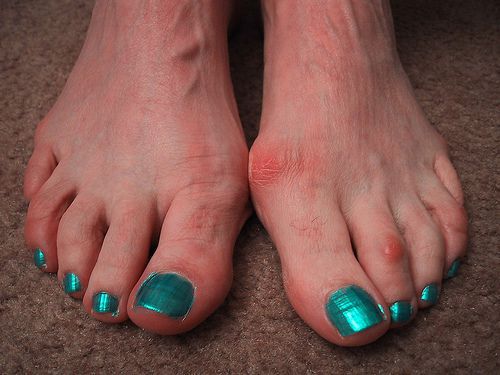
I get a lot of questions about what measures are helpful for conservative care of bunions. I think it is important to know that although there are no conservative measures that will ever reverse, fix or change the size or appearance of your bunion there are a few things you can do to help slow the progression of it. The only effective measure to ever fix or remove your bunion is surgical. There are a few things you can do to make your bunion more comfortable.
The first thing I always recommend is stretching your calf muscles. Your calf muscles impart force on your feet and lengthening them can help reduce this force. Google a couple calf stretching exercises and perform them a few times a day.
Secondly, no bare feet can be helpful. Most people that develop a bunion have a mechanically unstable foot. Wearing a sandal or slipper around the house can help slow the deforming forces creating the bunion. I like a good recovery sandal or a nice pair of slippers with arch support. Socks do not count, they do nothing to support your foot.
A prescription orthotic is your biggest help in slowing down the progression of your bunion. We are not talking about something you buy online, buy from a shoe store or some other venue. A prescription orthotic is made by a physician. This is a medical device that is often covered by insurance. This is made after a biomechanical examination of the lower extremity and gait. This is often done with a 3-D image of the foot to capture the foot structure.
Things that absolutely do not work and are a waste of money. Toe correction devices you see online. If a bunion could be fixed this way, there would never be another bunion surgery ever. Toe spacers can be helpful in reducing rubbing but again these will not fix your bunion. If you are suffering from bunion pain I can help. Give us a call at 425-391-8666 or make an appointment online today.
Sincerely,
Dr Brandon Nelson
Dr Brandon Nelson, A Board-Certified Physician & Surgeon Discusses Everything You Need To Know About Your Bunion

Bunions are primarily a genetic foot structure that is inherited from mom or dad. We see that it can skip generations as well. There seems to be a misconception that the bunion is just a growth on the side of the foot. However, this is not true. The bunion is a misalignment of the first metatarsal. It occurs when the first metatarsal separates or begins to deviate from the second metatarsal towards the other foot. This in turn causes the big toe to deviate or point towards the second digit. The growth or bump that one sees is the first metatarsal pointing out of the joint. This concept is important to understand as it will make sense when I discuss bunion correction.
Bunion correction refers to removal or reversal of the bunion. Well now that you understand it is a deviation, more correctly a progressive deviation of the first metatarsal, you can see why certain things will not correct a bunion. I have seen all sorts of strapping, taping and splinting techniques to correct a bunion. Now that it is clear this is a movement of a bone you can clearly see why none of this works. It is not possible to move the first metatarsal back into place once it has deviated via any sort of appliance or device you apply to the outside of the foot. Once the bone has moved the only option to correct the bunion is surgical.
Surgical correction of the bunion is the only way to reverse this misalignment. This is the only avenue we have to bring the big toe back into the correct orientation. There are many different techniques based on the size of the bunion and the rest of the foot structure. If you have a bunion and need help please schedule an appointment. Give us a call at 425-391-8666 or make an appointment online today.
Sincerely,
Toenail Fungus
Toenail fungus is a frustrating problem that affects many people. It can be persistent and hard to get rid of. As many different types of fungi are present throughout the environment, it is very easy to contract toenail fungus.
The feet are especially susceptible to toenail fungus because shoes and socks create the ideal dark and moist environment that fungal infections thrive in. While fungal infections of the nail plate are quite common, if left untreated they can spread beyond the toenail and into the skin and other parts of the body.
Signs of toenail fungus include a thickened nail that has become yellow or brown in color, a foul smell, and debris beneath the nail. The toe may become painful due to the pressure of a thicker nail or the buildup of debris.
Treatment for toenail fungus is most effective during the early stages of an infection. If there is an accumulation of debris beneath the nail plate, an ingrown nail or a more serious infection can occur. While each treatment varies between patients, your podiatrist may prescribe you oral medications, topical liquids and creams, or laser therapy. To determine the best treatment process for you, be sure to visit your podiatrist at the first signs of toenail fungus.
Symptoms of Toenail Fungus
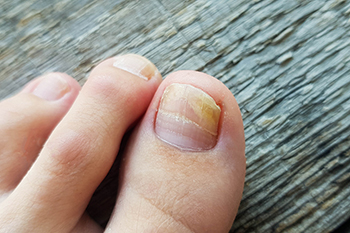
Many people won't pay attention to their toenails unless there is a change in color or texture. This can happen from having toenail fungus, an unsightly fungal infection of the toenail. The medical name for this ailment is known as tinea pedis and the fungus that causes this lives in warm environments. These can include shower room floors, public swimming pools, and similar areas. Since toenail fungus is contagious it is best to wear appropriate shoes while in these areas. Common symptoms that many patients experience can consist of itchiness between the toes and on the bottom of the feet, and the skin may be red and flaky. One of the first signs a toenail infection may be developing is the discoloration of the toenails. They may change to a yellow or whitish color, and it is beneficial to seek medical attention when this is noticed. If you have signs of having toenail fungus, it is suggested that you speak with a podiatrist who can effectively treat this condition.
If left untreated, toenail fungus may spread to other toenails, skin, or even fingernails. If you suspect you have toenail fungus it is important to seek treatment right away. For more information about treatment, contact the podiatrists of Issaquah Foot & Ankle Specialists. Our doctors can provide the care you need to keep you pain-free and on your feet.
Symptoms
- Warped or oddly shaped nails
- Yellowish nails
- Loose/separated nail
- Buildup of bits and pieces of nail fragments under the nail
- Brittle, broken, thickened nail
Treatment
If self-care strategies and over-the-counter medications does not help your fungus, your podiatrist may give you a prescription drug instead. Even if you find relief from your toenail fungus symptoms, you may experience a repeat infection in the future.
Prevention
In order to prevent getting toenail fungus in the future, you should always make sure to wash your feet with soap and water. After washing, it is important to dry your feet thoroughly especially in between the toes. When trimming your toenails, be sure to trim straight across instead of in a rounded shape. It is crucial not to cover up discolored nails with nail polish because that will prevent your nail from being able to “breathe”.
In some cases, surgical procedure may be needed to remove the toenail fungus. Consult with your podiatrist about the best treatment options for your case of toenail fungus.
If you have any questions please contact one of our offices located in Issaquah, WA . We offer the newest diagnostic and treatment technologies for all your foot and ankle needs.
Check if allow_url_fopen is enabled on your server. It is mandatory. If not then you must activate it. Contact with your Server Admin / Hosting Provider.
Steps to enable allow_url _fopen :
allow_url_fopen = on
allow_url_include = on.
Add it to php.ini settings.
Google Business Reviews Error Notice!
Read Below Steps Carefully :
1. Check your API key and PLACE id. May be it is not right. Make sure it is correct one.
2. This message commonly shows when api key is exceeded daily request quota for this API or there is no active billing account for this API. Because according to Google there is a limit for free API key. If it exceeds they ask for billing.
3. To know more about Google Pricing , Check here : Google Pricing
4. You can create your Google API key here
5. Must use a right PlaceID. Get PlaceID here
6. One important thing, Don't forget to add billing account to Google. Must check what Google says here
7. If you still find issue , then check first if your Business registered with Google or not. Read more about it here
8.Still find issue, then contact developer : info@aaextensions.com or ashik685@gmail.com
